News Research
17 observations, stale lidar, and a 73,000-parameter brain
How our lidar driving policy works, and the timing bug that turned out to be one of our biggest unlocks.
Our current driving policy reads 17 numbers and outputs 2: steering and drive. It runs 15 times a second on the car's Jetson Orin Nano.
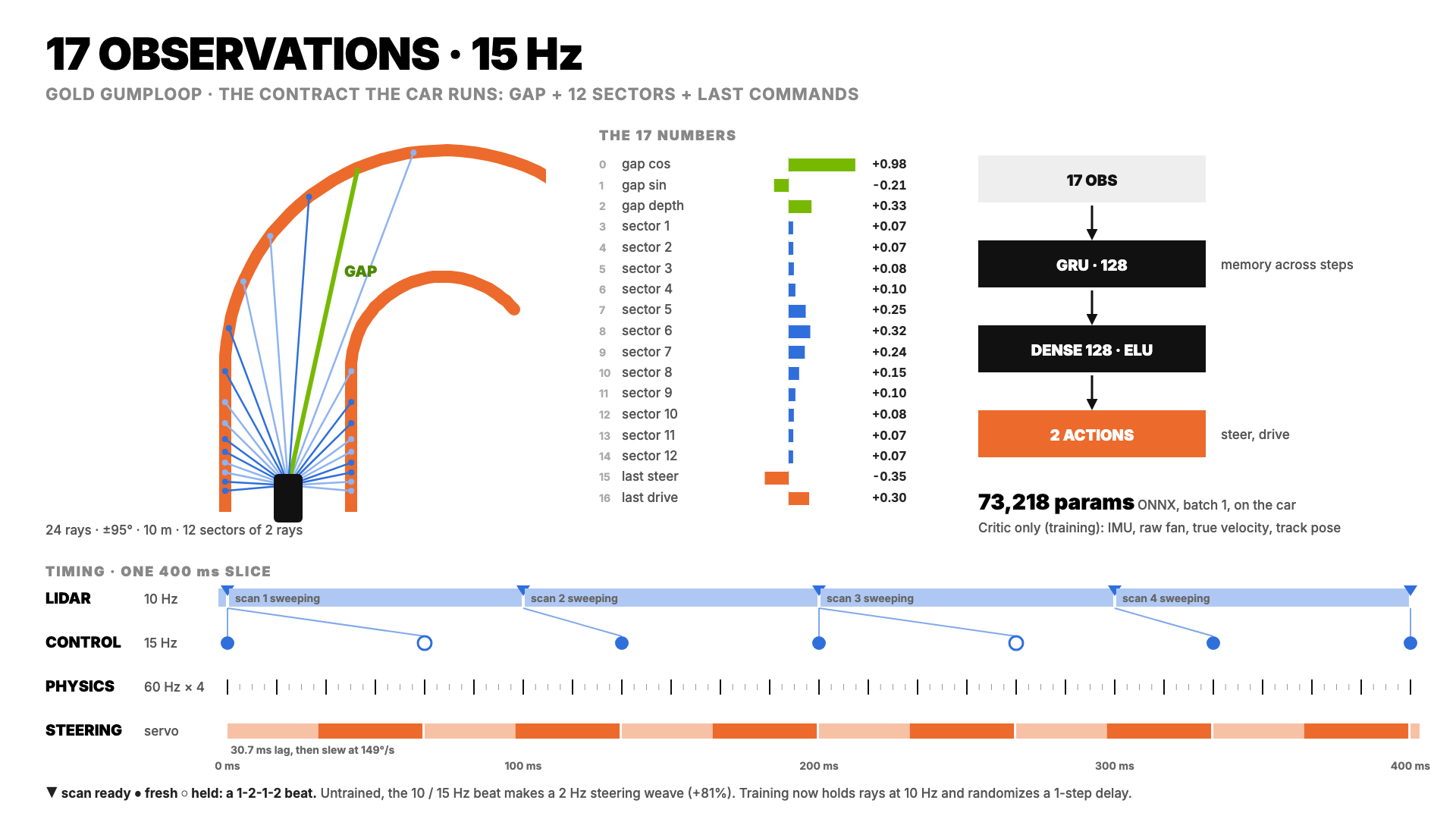
The 17 numbers
- The gap. Cosine and sine of the angle to the biggest open gap, plus how deep it is.
- 12 lidar sectors. 24 rays across ±95°, out to 10 m, paired into 12 sectors.
- Last commands. The previous steering and drive.
A GRU with 128 units gives the policy memory across steps. Then one dense layer, then the two actions. The whole network is 73,218 parameters, exported to ONNX and run with no cloud connection.
During training, the critic sees more than the car does: the IMU, the full lidar fan, true velocity, and the car's pose on the track. The car never needs those at run time.
The timing bug
The lidar scans at 10 Hz. The policy runs at 15 Hz. So the policy sees a fresh scan, then a held one, in a 1-2-1-2 beat. Untrained for this, that beat caused a 2 Hz steering weave.
The fix was to train on stale data. The simulator now holds rays at 10 Hz like the real sensor and randomizes a one-step delay. This was one of the big unlocks. Memory from the GRU helped too, including with lidar multipath.
Still to do
At 3 to 5 m/s through a hairpin, it still crashes more than we would like. That is the next problem.