News Research
Warp kernels: 2.4× faster training on one RTX 4090
How we cut one simulation step for 1,024 cars from 44.6 ms to 18.6 ms with NVIDIA Warp and Newton.
Training speed decides what you can try. A faster simulator means more experiments a day, bigger curricula, and richer behaviors. In two days in October we made our training environment 2.4 times faster.
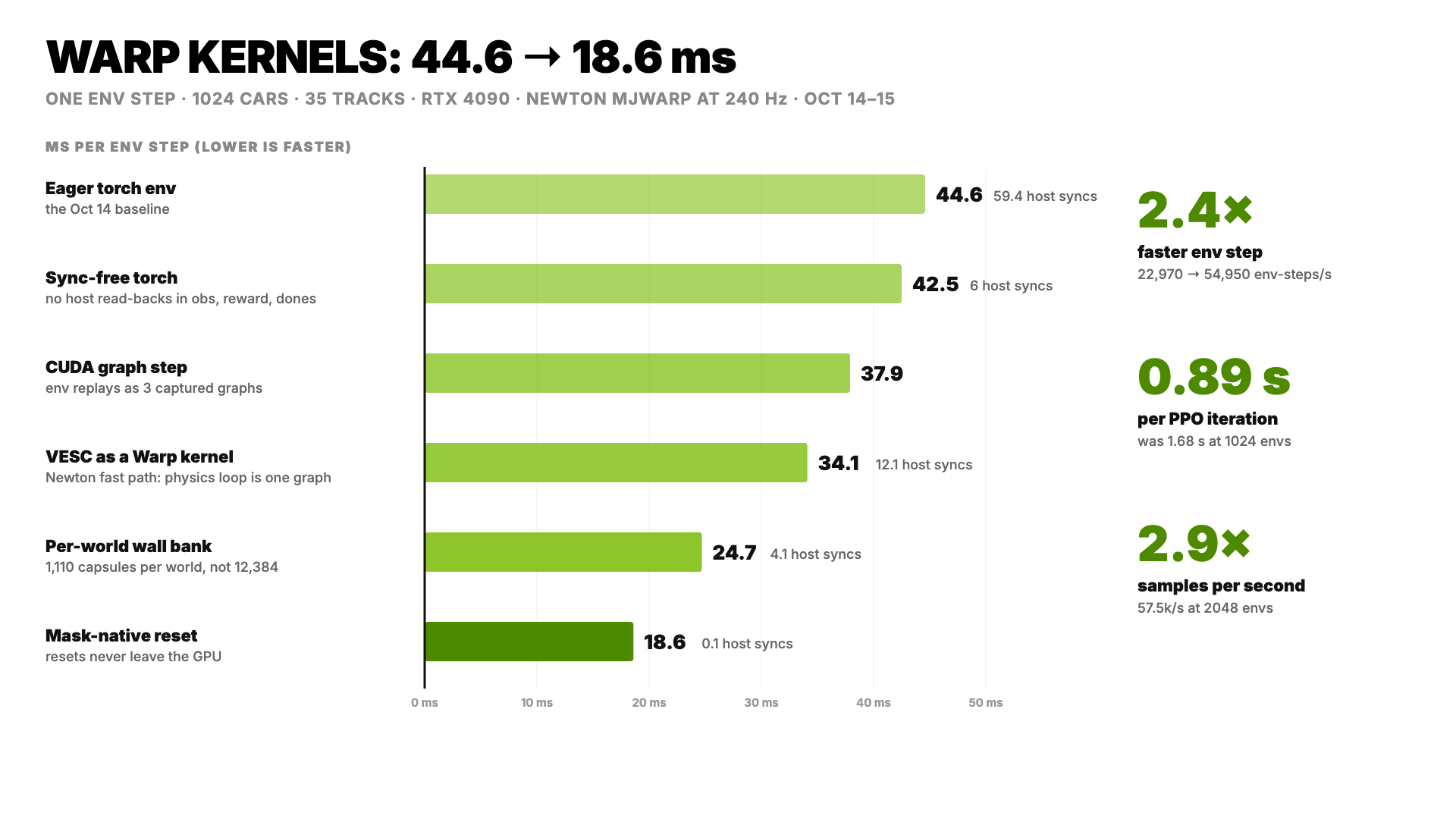
The setup
1,024 cars on 35 tracks, simulated with NVIDIA Newton's MuJoCo Warp solver at 240 Hz, on a single RTX 4090.
Six steps
- Eager PyTorch environment: 44.6 ms. The baseline, with about 59 host syncs per step.
- Sync-free PyTorch: 42.5 ms. No host read-backs in observations, rewards, or resets.
- CUDA graph step: 37.9 ms. The environment replays as three captured graphs.
- The motor controller as a Warp kernel: 34.1 ms. The physics loop becomes one graph.
- Per-world wall bank: 24.7 ms. 1,110 wall capsules per world instead of 12,384.
- Mask-native reset: 18.6 ms. Resets never leave the GPU.
The result
- 2.4× faster environment steps: 22,970 to 54,950 steps per second.
- 0.89 s per PPO iteration, down from 1.68 s at 1,024 environments.
- 2.9× more samples per second: 57,500 per second at 2,048 environments.
Newton also lets us swap physics solvers. That idea is familiar from years of chip design, where mechanical and thermal solvers had to be stitched together.