News Research
Not too easy, not too hard: why a race car
Physical AI needs a robot that is hard enough to be real and simple enough to learn on. Here is why we picked a 1/10-scale rally car.
Robots are no longer programmed one rule at a time. They learn. Thousands of copies of a robot train in simulation at once, and the policy they learn runs on the real machine. That is physical AI, and it is how the next generation of robots will be built.
To learn it, you need a robot. Picking the right one matters more than most people think.
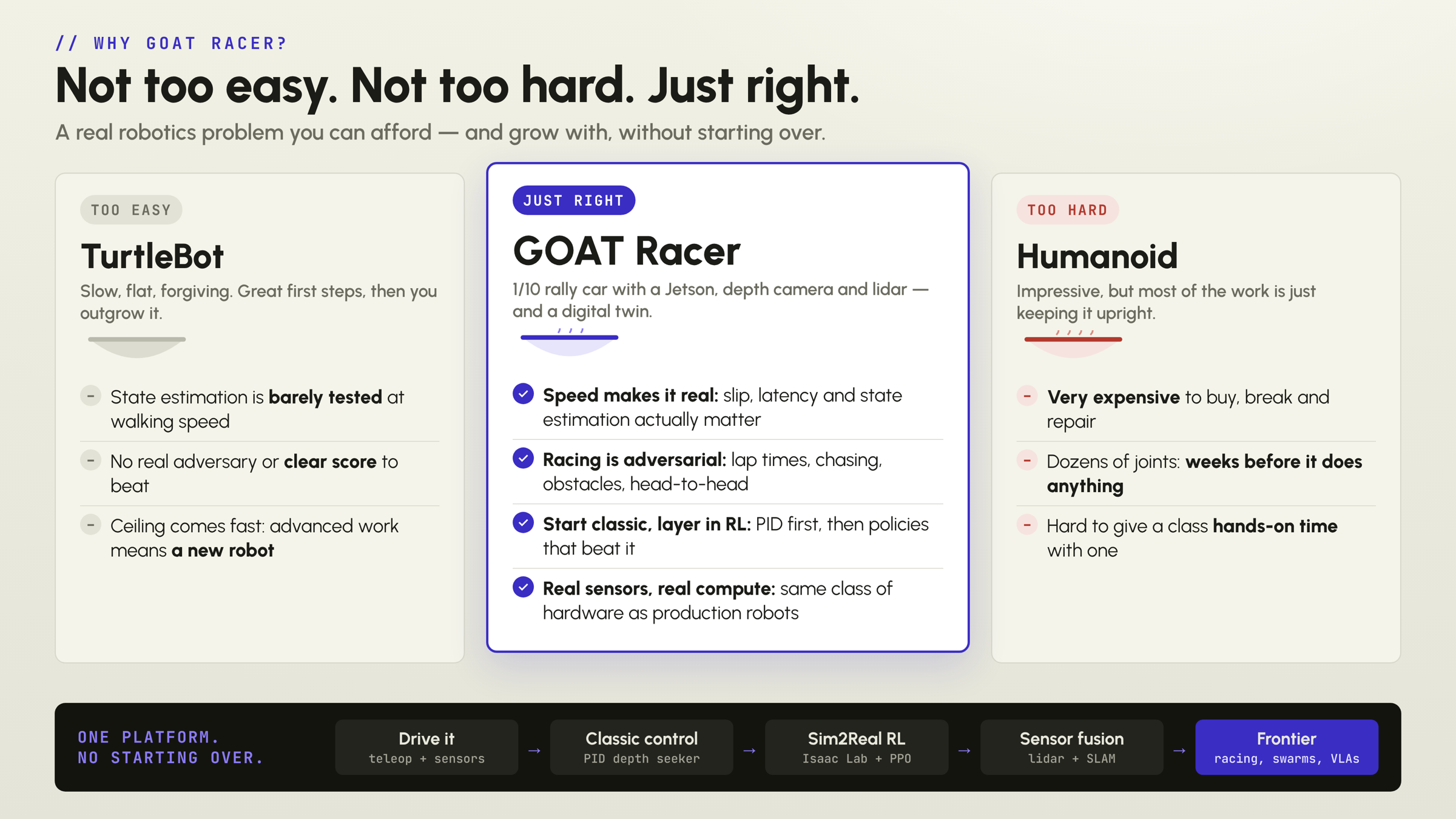
Too easy
A TurtleBot is slow, flat, and forgiving. It is great for first steps, and then you outgrow it. State estimation is barely tested at walking speed. There is no real adversary and no clear score to beat. The ceiling comes fast: advanced work means buying a new robot.
Too hard
Humanoids are impressive, but most of the work is keeping them upright. They are very expensive to buy, break, and repair. Dozens of joints mean weeks of setup before the robot does anything. And it is hard to give a whole class hands-on time with one.
Just right
GOAT RACER is a 1/10-scale rally car with an NVIDIA Jetson, a depth camera, a lidar, and a digital twin.
- Speed makes it real. Slip, latency, and state estimation actually matter.
- Racing is adversarial. Lap times, chasing, obstacles, head-to-head. You always know if you got better.
- Start classic, then layer in RL. PID first, then policies that beat it.
- Real sensors, real compute. The same class of hardware as production robots.
"We're using the same tools that you use on a $100,000 humanoid."
Steer, throttle, brake: the whole action space fits in your head on day one. A car is cheap to crash and easy to fix. That leaves your time for the part that matters, the loop from simulation to the real world.
One platform, no starting over
- Drive it. Teleop and live sensors.
- Classic control. A PID depth seeker. No model, just feedback.
- Sim2real RL. Train with PPO in Isaac Lab and deploy to the car.
- Sensor fusion. Lidar, depth, and SLAM.
- Frontier. Racing, swarms, and vision-language-action models.
Each step uses the same car. You never have to start over.